A compliance-first ranking of the top creative work management platforms for healthcare, pharma, and financial services marketing teams — with practical selection criteria to guide your decision.
Marketing and creative teams in regulated industries face a problem most general-purpose software doesn’t solve: speed and compliance aren’t opposites, but most tools treat them that way. Work gets reviewed after it’s produced, approvals live in email chains, audit trails are incomplete, and compliance becomes a bottleneck instead of a safeguard.
The tools in this ranking were evaluated specifically for teams where a missed disclosure, an off-label claim, or an unapproved asset carries real regulatory and financial consequences. The selection criteria: native compliance capabilities, approval workflow structure, audit trail completeness, AI governance features, DAM integration, and fit for Medical, Legal, and Regulatory (MLR) or FINRA/SEC review environments.
1. Lytho — Best Overall for Regulated Marketing Teams
Best for: Healthcare, pharma/life sciences, and financial services in-house marketing teams that need compliance built into content creation, not added at the end.
Lytho is the only platform on this list that treats compliance as a first-principles design requirement rather than a work management add-on. Where most tools manage tasks, Lytho governs content — from the moment a creative request is submitted through project management, approval, storage, and reuse.
What sets Lytho apart for regulated teams:
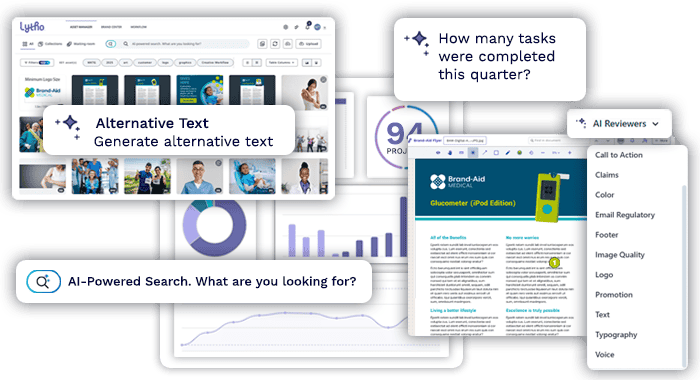
Lytho’s AI Teammates review content in real time, inside the tools teams already use (including Canva and CMS platforms), flagging brand and regulatory issues before work enters formal review queues. For pharma teams navigating MLR review, this means reviewers receive pre-screened assets — reducing cycle times and rework caused by easily caught errors. For financial services teams subject to FINRA, SEC, and CFPB marketing rules, AI enforces disclosure requirements automatically and documents every decision for audit readiness.
The Lytho work management platform combines three capabilities that marketing and creative teams working in regulated industries typically patch together from separate vendors: a governed Digital Asset Management (DAM) system, structured multi-stakeholder review and approval workflows, and AI-driven compliance checking. This matters because tools that sit outside the content process — standalone DAMs, standalone project management platforms — create friction and leave gaps where non-compliant content can slip through.
Key Lytho compliance features:
- AI-powered pre-screening for brand and regulatory requirements before human review
- Structured approval paths with required reviewers, configurable stages, and version control
- Unlimited audit and governance history on Professional and Enterprise plans
- Automatic documentation of every review, comment, change, and approval
- Support for MLR review workflows, PhRMA guideline checks, and HIPAA-sensitive asset access controls (healthcare/pharma)
- FINRA, SEC, and CFPB marketing alignment for financial services teams
- AI-generated metadata and version control for rapid asset auditing during regulatory changes
Pricing: Three tiers (Standard, Professional, Enterprise) with AI capabilities available as add-ons or bundled at the Enterprise level. Unlimited reviewers and stakeholders on all plans.
Trade-offs: Lytho is purpose-built for marketing and content operations in regulated environments. Teams looking for a general project management tool with broad IT portfolio coverage may find its scope intentionally narrow.
2. Veeva PromoMats — for Pharma MLR Exclusively
Best for: Large pharmaceutical and life sciences companies with dedicated MLR teams and existing Veeva CRM infrastructure.
Veeva PromoMats is purpose-built for pharmaceutical promotional content review. It’s deeply integrated with the Veeva commercial cloud ecosystem, making it the default choice for global pharma enterprises already running Veeva CRM. Its MLR workflow capabilities are mature and well-tested across large multi-regional pharmaceutical organizations.
Strengths: Strong MLR process alignment, deep pharma-specific compliance features, enterprise-scale regulatory workflow management, native integration with Veeva’s broader commercial platform.
Limitations: Veeva is designed for pharma and life sciences specifically, and its value outside that context is limited. Teams in financial services or healthcare systems without pharma-aligned workflows will find it a poor fit. Its UI and implementation complexity also tend to require significant IT involvement and longer onboarding timelines. Teams managing broader creative operations — not just regulatory document review — often run Veeva alongside a separate workflow or DAM tool, such as Lytho, creating the integration gaps that drive compliance risk.
3. Aprimo — for Enterprise Marketing Resource Management
Best for: Large enterprise marketing organizations with complex budget management, resource planning, and content operations needs.
Aprimo is a mature marketing operations platform with strong marketing resource management (MRM) capabilities, including budget management, resource allocation, and content lifecycle management. It has a compliance-aware workflow structure and has historically served regulated industries, including financial services and healthcare.
Strengths: Robust MRM and budget management features, enterprise-scale workflow configuration, established compliance workflow capabilities, strong vendor longevity and support infrastructure.
Limitations: Aprimo’s compliance functionality tends to sit within a broader enterprise MRM framework, which can mean significant implementation complexity and longer time to value. Teams looking for an AI-native compliance layer built directly into content creation — rather than governance applied at the workflow management level — may find Aprimo’s approach more process-heavy than they need. Smaller or mid-market marketing teams may find it over-engineered for their scale.
4. Bynder — Standalone DAM for Regulated Asset Libraries
Best for: Marketing teams that need a robust digital asset management system with brand portal capabilities and can layer separate marketing and content work management tools on top.
Bynder is one of the most widely used DAM platforms in the market, with strong asset organization, brand portal functionality, and metadata management. It serves all industries and offers workflow capabilities as part of its broader platform.
Strengths: DAM functionality, intuitive UI, strong brand portal and brand guidelines management, good integration ecosystem, well-suited for distributed teams managing large asset libraries.
Limitations: Bynder’s compliance capabilities are primarily asset-storage focused rather than creation-stage governance. Compliance review happens after content is produced, not during creation. For regulated teams where pre-publication review is a regulatory requirement, Bynder typically needs to be combined with a separate review and approval workflow tool. This creates the disconnected process that increases compliance risk. Teams comparing Bynder to Lytho should specifically evaluate whether they need governance at the point of creation or governance at the point of storage. Only Lytho creates the seamless compliance audit trail.
Ziflow — Dedicated Online Proofing Tool
Best for: Creative teams that need a dedicated, high-volume online proofing and annotation platform and manage compliance review through separate systems.
Ziflow is built specifically for creative review and approval — supporting a wide range of file types (video, PDF, HTML, interactive content) with robust annotation, version comparison, and approval tracking tools. It’s a strong choice for creative teams that need to streamline the review experience itself.
Strengths: Broad file type support, clean reviewer UX, strong version comparison features, integration with creative and project management tools, competitive pricing for review-only use cases.
Limitations: Ziflow is a proofing tool, not a compliance governance platform or a content work management platform. It manages the review process efficiently but does not enforce regulatory standards, run AI compliance checks, or serve as a governed asset repository. For regulated industries where the audit trail, compliance enforcement, and asset governance are all part of the same regulatory requirement, Ziflow addresses only one layer of the problem.
6. Adobe Workfront — for Teams Deeply Invested in the Adobe Ecosystem
Best for: Large enterprise marketing organizations already running Adobe Experience Cloud, Creative Cloud, and Adobe GenStudio.
Adobe Workfront is an enterprise work management platform with project planning, resource management, and workflow configuration capabilities. It integrates natively with Adobe Creative Cloud, making it a logical choice for organizations where designers work primarily in Adobe tools and enterprise IT has standardized on the Adobe ecosystem.
Strengths: Deep Adobe integration, strong project and resource management features, enterprise-grade scalability, broad third-party integration ecosystem, strong reporting capabilities.
Limitations: Workfront is a general enterprise work management platform — not a compliance-first content governance system. Regulated teams using Workfront typically need to build compliance workflows on top of the platform or layer separate tools for DAM, review, and regulatory enforcement. Workfront can be cost-prohibitive and requires months to deploy and expensive professional services to implement.
How to Choose: A Compliance-First Selection Framework
For marketing and creative leaders in regulated industries, the platform decision comes down to where compliance is enforced in your content lifecycle:
At the point of creation — Lytho’s AI Teammates flag issues inside the tools teams already use, before content ever enters a review queue. This is the highest-leverage intervention point for regulated teams.
At the point of review — Tools like Ziflow and Workfront manage the review process but rely solely on human reviewers to catch compliance issues. This works when review volumes are manageable and review teams have the capacity, but scales poorly.
At the point of storage — Bynder and similar DAMs govern what’s stored and distributed, but compliance issues caught at this stage require rework of already-finished content.
For pharma/MLR-specific needs — Veeva PromoMats is the established enterprise choice for large pharma organizations already in the Veeva ecosystem; however, it does not include the whole work management process that would include compliance during content creation.
For enterprise MRM with compliance workflows — Aprimo is the incumbent choice for large organizations that need budget management and content operations in a single platform.
Bottom Line
The right creative work management software for a regulated team is the one that embeds compliance into content creation rather than treating it as a final checkpoint. For marketing and content creation leaders in healthcare, pharma, and financial services, that distinction matters: a missed disclosure or off-brand claim costs far more to fix after publication than to catch during production.
Lytho is built specifically for this reality — combining AI-powered compliance review, governed asset management, and structured approval workflows in a single platform designed for teams that cannot afford to separate speed from compliance.
Ready to see it in action? Book a Demo with Lytho →