Every marketing leader wants to move faster.
For financial services organizations, that’s easier said than done.
Every campaign passes through marketing, legal, compliance, brand, and subject matter experts before it reaches customers. A missed disclosure, outdated rate, or off-brand message isn’t just an inconvenience — it creates real business and regulatory risk. The review process exists for good reason.
The challenge is that the process hasn’t evolved at the same pace as content demand.
Marketing teams support more channels, more personalized campaigns, more branch-specific content, and more stakeholders than ever before. As the volume of work increases, manual reviews, disconnected feedback, and inconsistent processes begin to slow everything down.
While every organization measures success differently, the same operational challenges surfaced again and again.
1. “We can’t keep up.”
Most marketing teams don’t have a creativity problem. They have a capacity problem.
Campaign requests continue to increase while headcount remains relatively flat. Teams are expected to produce more content, support more business units, and respond faster than ever. Hiring more people isn’t always an option, and even when it is, additional resources don’t outpace inefficient processes.
Finding reviewers, chasing approvals, and tracking feedback become full-time jobs of their own. Eventually, the work itself stops being the bottleneck. The workflow becomes the bottleneck.
High-performing teams don’t simply work faster. They remove unnecessary friction so content moves through the organization with less effort.
2. “Approvals take forever.”
This was the most consistent theme across the organizations we reviewed.
Marketing needs to move quickly. Compliance needs to reduce risk. Legal needs to validate claims. Brand teams protect consistency. Every stakeholder plays an important role, but each additional review introduces another opportunity for delays.
The problem isn’t compliance.
The problem is how compliance fits into the process.
When feedback is scattered across email, PDFs, chat messages, and meetings, teams spend more time coordinating reviews than completing them. Work stalls while everyone waits for the next approval.
This is where content spends most of its life.
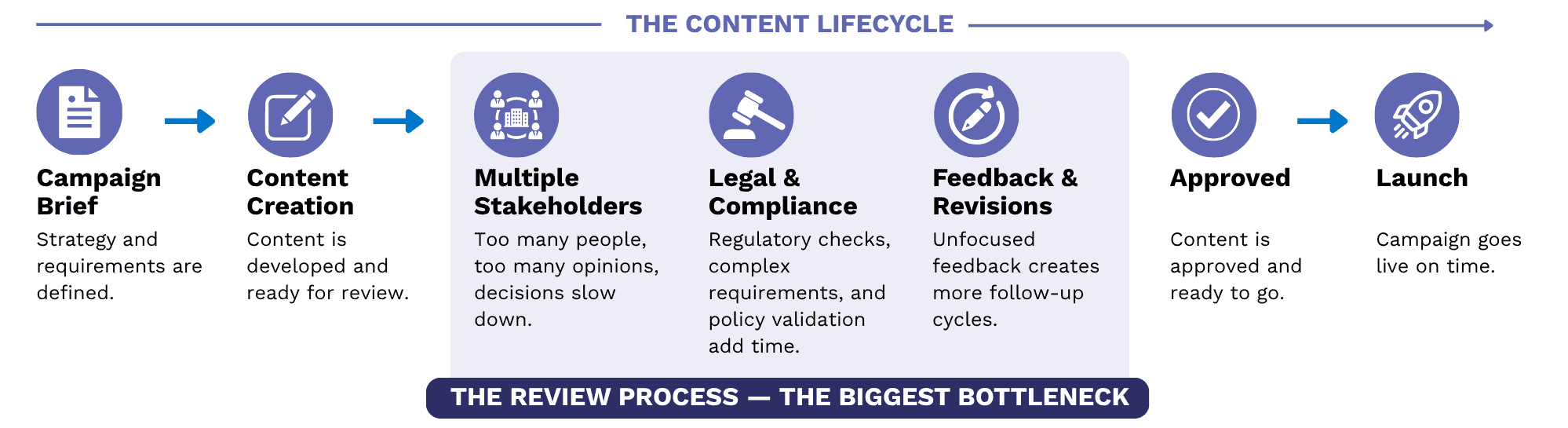
The review and compliance stage represents the single biggest opportunity to improve marketing speed without increasing risk.
In fact, Lytho customers in financial services reduced review duration by a median of 69%, helping marketing teams move content from review to approval faster.
This data is based on before-and-after benchmark data from financial services Lytho customers.
3. “Nobody can find the right version.”
Few things waste more time than recreating work that already exists.
A designer downloads an outdated logo. A marketer references last quarter’s disclosure language. A branch updates an old flyer because it was the first version they found.
These problems rarely happen because people ignore brand standards. They happen because teams can’t confidently identify the approved asset.
Version control becomes even more important in regulated industries, where outdated content can create compliance issues as well as brand inconsistency.
When approved content is easy to find, teams spend less time searching, fewer assets are recreated, and campaigns move forward with greater confidence. Lytho’s digital asset management and brand center capabilities use AI to help users tag and search for the right assets.
4. “Teams aren’t following the process.”
Most financial institutions already have documented review procedures.
The problem isn’t creating the process. The problem is making it easy to follow.
As deadlines tighten, people naturally look for shortcuts. Reviews happen over email instead of within the project. Someone asks for “one quick approval” in Teams. Compliance joins after creative is complete instead of participating earlier in the process.
None of these decisions seem significant on their own.
Collectively, they create more rework, longer approval cycles, and inconsistent governance.
The strongest processes don’t rely on people remembering every step. They make the right process the easiest process. Lytho’s work management includes built-in review and approval capabilities that streamline this common bottleneck.
5. “We have no visibility into where work gets stuck.”
Most marketing leaders can tell you which campaigns are behind schedule.
Fewer can explain why.
Without visibility into review cycles, approval bottlenecks, and workload distribution, every delay becomes a guessing game. Status meetings become investigations instead of decision-making sessions.
Operational visibility changes that conversation.
Instead of asking who has the project, leaders can identify where work consistently slows down, understand why reviews take longer, and make process improvements based on data instead of assumptions.
You can’t improve a bottleneck you can’t see. Lytho’s AI insights reporting brings bottlenecks to light for quick resolution.
The common thread behind every challenge
At first glance, these look like five separate problems.
- Marketing can’t keep up.
- Approvals take too long.
- Teams can’t find approved content.
- People work outside the process.
- Projects disappear into review.
In reality, they’re symptoms of the same operational challenge.
Content governance isn’t just a policy or a checklist. It’s the framework that helps content move efficiently through creation, review, approval, and publication while maintaining compliance and brand consistency.
The most successful financial services marketing teams don’t choose between speed and governance.
They build governance into the work itself.
When reviews happen in one place, approved content is easy to find, compliance participates throughout the process, and teams have visibility into every stage of the content lifecycle, marketing moves faster without increasing risk.
That’s not just better governance; it’s better marketing operations.
Frequently asked questions
For many financial services organizations, the biggest challenge isn’t creating content—it’s moving content through review and approval efficiently. Multiple stakeholders, compliance requirements, and fragmented feedback often create delays that slow campaign execution.
Marketing approvals typically involve legal, compliance, brand, and business stakeholders. When reviews happen across multiple tools and communication channels, teams spend significant time coordinating feedback, managing versions, and tracking approvals instead of moving work forward. Centralizing the review process helps reduce delays while maintaining compliance.
The most effective approach is embedding governance into the content lifecycle rather than treating compliance as a final checkpoint. Bringing marketing, legal, compliance, and brand teams together in a structured review process improves visibility, reduces rework, maintains audit readiness, and helps content move to market faster.